← Back
Organisational Design3 min read29 October 2026

HR in Holding Groups: What to Centralise and What to Leave Local

Holding groups must decide which HR decisions sit with the group and which with each business. A practical guide to balancing consistency and local flexibility.

Holding groups are common in the UAE and across the GCC: a parent company with interests in several businesses, often in different sectors, sometimes across free zone and mainland entities and more than one country. Each business may have grown with its own HR practices, grading, pay levels and policies.

At some point the group asks whether that variety is a strength or a problem. The honest answer is usually both. The task is to decide which parts of HR benefit from consistency and which work better close to each business.

The spectrum

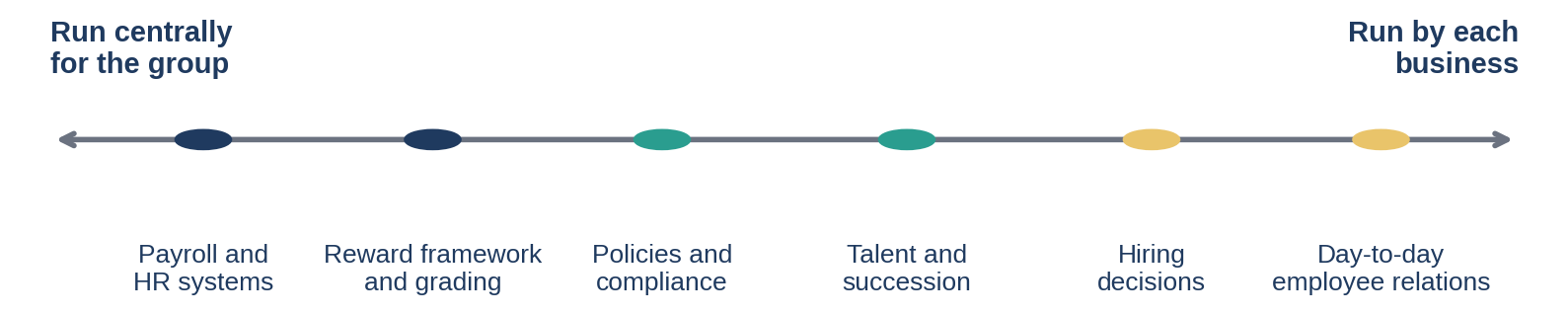
Illustrative: where HR activities often sit in a group

Illustrative only: the right position for each activity depends on the group

There is no single correct model. A group of closely related businesses may centralise much more than a diversified group with very different operations. The useful question for each HR activity is: does consistency across the group add more value than local flexibility?

What often works centrally

Grading framework. A common grading structure lets the group compare roles across businesses, move people between them and govern senior pay.

Executive and senior pay. Pay for top roles in each business is usually reviewed and approved by the group.

Core policies. A group-wide policy set covering conduct, data protection and other compliance areas reduces risk, with local variations where entity rules differ.

HR systems and payroll. Shared systems reduce cost and give the group consistent data.

Talent and succession for critical roles. Group-level visibility of senior talent allows people to move to where they are most needed.

What often works locally

Hiring decisions for most roles, within group frameworks.

Day-to-day employee relations, handled by managers and local HR who know the people.

Pay ranges where businesses operate in different sectors or markets with very different pay levels.

Engagement action planning, using group survey tools but local priorities.

Signs the balance is wrong

Too centralisedToo decentralised
Local businesses wait weeks for routine approvalsSimilar roles carry different grades and pay across the group
Group policies ignore sector or entity differencesPeople cannot move between businesses without renegotiating terms
Local HR has no real authorityThe group cannot see its senior talent or total people cost
Managers work around group processesEach business buys the same services separately

Making the model work

  • Write down decision rights. For each major HR decision, record who decides, who is consulted and who is informed.
  • Set minimum standards rather than identical processes. Each business meets the standard in a way that suits it.
  • Build a small group HR team focused on frameworks, governance and senior talent, not on doing every business's HR work.
  • Use shared data. A common view of headcount, cost and pay across the group makes governance practical.
  • Review the model as the group's portfolio changes.

How Humatix can help

Humatix works with holding groups across the GCC on group HR models, common grading frameworks, pay governance and decision rights, balancing consistency at group level with flexibility for each business.