← Back
HR Strategy3 min read21 October 2026

Designing the HR Function for a Growing Organisation

How growing UAE and GCC organisations can design their HR function: business partners, centres of expertise, HR operations, and what to build in which order.

HR functions often grow the same way the rest of the business does: one hire at a time, in response to the most pressing problem. A payroll officer is added when salaries become complicated, an HR manager when policies are needed, a specialist when a big project arrives. The result can work, but it rarely adds up to a function designed around what the organisation needs.

Three parts of a modern HR function

Most HR operating models, whatever their size, combine three kinds of work.
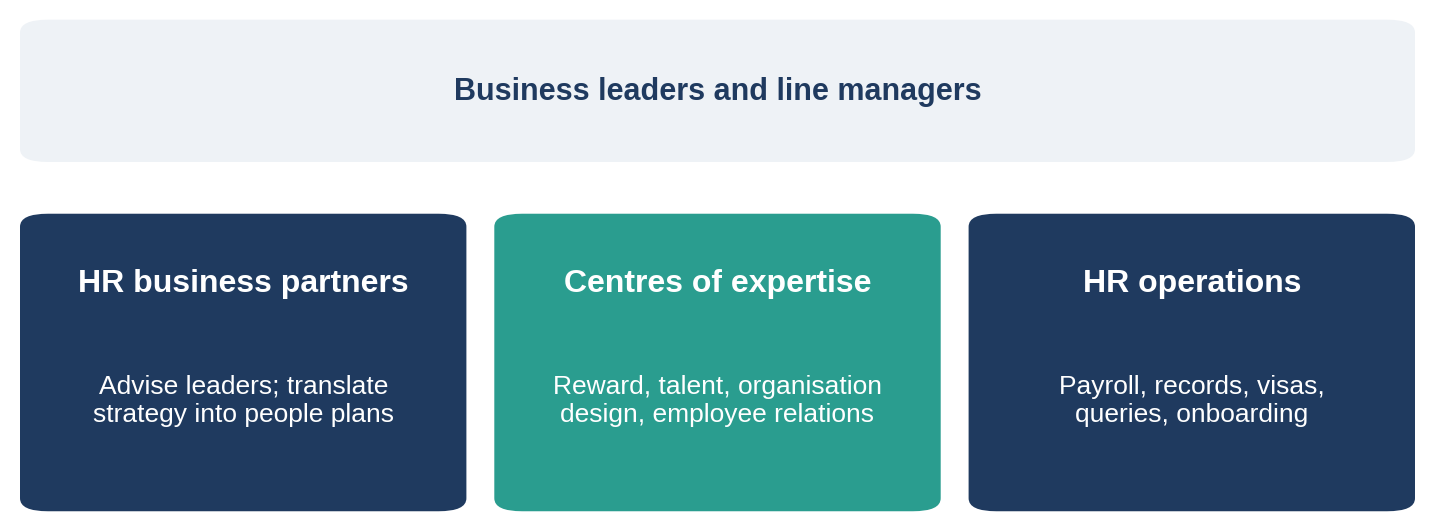
A common HR operating model, scaled to size

Three types of HR work; in smaller organisations one person may cover more than one

HR business partners work alongside business leaders, helping them plan their workforce, manage performance and handle change. Their value depends on understanding the business, not just HR.

Centres of expertise hold specialist knowledge, such as reward, organisation design, talent and assessment, or employee relations. They design frameworks and policies that the rest of HR applies.

HR operations delivers the day-to-day service: payroll, records, visas and permits, onboarding, queries. It needs consistency and good systems more than anything else.

Scaling it to your size

A small organisation will not have three separate teams. The model is still useful, because it shows which types of work need covering and who covers them.

SizeTypical shape
SmallOne HR generalist covering operations and partnering; specialist work bought in when needed
GrowingAn HR manager acting as partner to leadership, an operations team, and selected specialist support
Mid-sizedDedicated business partners for major divisions, a central operations team, one or two in-house specialists
Large or multi-entityFull business partner network, centres of expertise and a shared services operation across entities

What to build first

For most growing organisations, the sequence that works is:

  • Reliable operations. Accurate payroll, records and compliance come before anything else. Nothing damages HR's credibility faster than errors here.
  • A trusted adviser to leadership. Someone who can sit with the leadership team and translate business plans into people decisions.
  • The core frameworks. Grading, pay ranges, performance management and policies, often designed with external support.
  • Specialist capability in the areas that matter most to the business, built or bought.

Decisions to make along the way

  • Centralise or devolve? Multi-entity groups need to decide which HR decisions are made centrally and which locally.
  • Build or buy specialist skills? Occasional work, such as job evaluation or benchmarking, is often better bought than built.
  • Which technology? Systems should follow the process design, not lead it.
  • How will HR be measured? A small set of service and outcome measures keeps the function focused.

Common pitfalls

  • Hiring senior HR business partners before operations are stable
  • Copying a large-company model into a small organisation
  • Specialists building frameworks that line managers find too complex to use
  • No clear owner for HR decisions in multi-entity groups

How Humatix can help

Humatix helps UAE and GCC organisations design their HR operating model, from assessing the current function to defining roles, structure and service standards, and supports the build with outsourced HR and specialist advisory work.

HR Operating Model Design for Growing Organisations