
← Back
Performance Management4 min read21 October 2026

Performance Management Beyond the Annual Review

One year-end meeting cannot settle ratings, bonuses and development. How UAE employers can split the work and run performance conversations all year.

Many UAE employers still ask a single year-end meeting to decide ratings, bonuses, promotions and development plans in one go. No conversation can carry that much. The result is usually a rushed discussion dominated by the bonus, with development squeezed into the last five minutes.

The fix is not to abolish appraisals. It is to give them a narrower job and spread the rest of the work across the year.

Where the annual review falls short

The traditional appraisal was designed for stable roles and predictable planning cycles. Few UAE businesses work that way now. Structures change as companies grow, priorities move mid-year, and in a mobile workforce many people join or leave part-way through the cycle. Relying on one meeting tends to produce four problems:

  • Recent events dominate. Last month is remembered far better than the first quarter.
  • Reward drowns out development. When both are discussed together, the bonus wins.
  • Opinion replaces evidence. Ratings drift towards overall impressions.
  • Problems surface late. A concern first raised at year-end may have affected months of work.

Two different questions

A performance appraisal asks whether agreed objectives were met over a period. A competency assessment asks how well someone demonstrates the knowledge, skills and behaviours their role requires. The first is about results; the second is about capability.
–Performance appraisalCompetency assessment
QuestionWere objectives achieved?How well does this person demonstrate what the role needs?
Looks atTargets, KPIs, delivered projectsKnowledge, skills, behaviours
Time frameThe period just endedCurrent capability and future readiness
Mainly informsPay and accountabilityDevelopment, promotion, succession
EvidenceResults data, quality of outputObserved behaviour against a framework

The two can diverge. A sales lead might beat target in a strong market while developing the team poorly, while a peer misses target in a difficult quarter but shows exactly the behaviours the organisation wants. An appraisal alone rewards the first and penalises the second. A competency view shows what produced each result and whether it is likely to be repeated.

A year-round rhythm

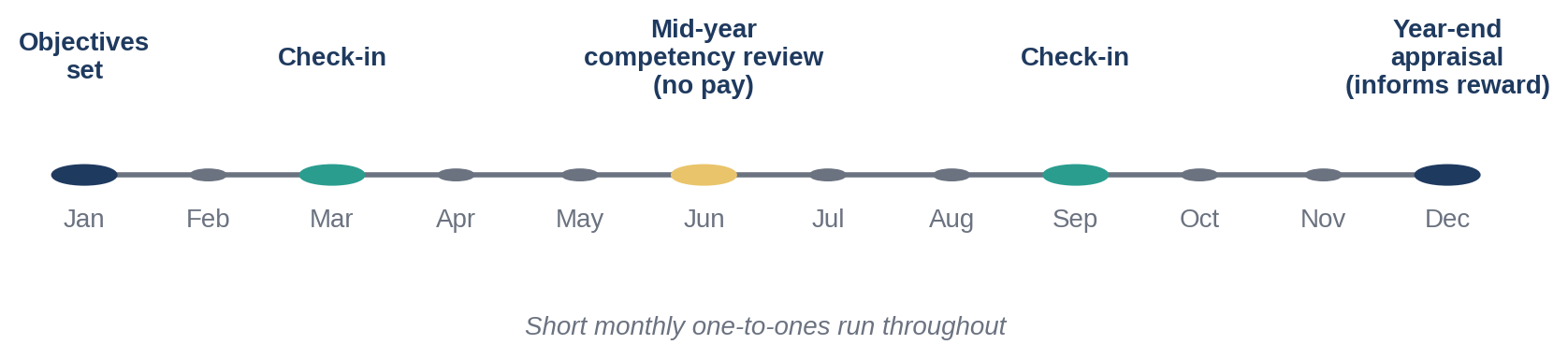
Spreading the conversations across the year

An illustrative calendar that separates development from reward

The aim is more frequent conversations, each with a clear purpose, not more paperwork. Short check-ins cover progress and any help needed. A mid-year review focuses only on development, with pay off the table; people admit skill gaps more readily when their bonus does not depend on it. The year-end appraisal then draws on evidence gathered across the year to inform reward.

Making assessment fair

Bias enters mainly through unstructured judgement, so structure is the main defence.

  • Keep the competency set small and write observable indicators for each level.
  • Write role profiles showing the level expected for each role.
  • Use more than one source: manager observation, peer input, work samples and self-assessment each show something different.
  • Ask for examples. Ratings should cite specific situations, not general impressions.
  • Calibrate across teams so a rating means the same thing in every department.
  • Link every gap to an action such as coaching, a stretch assignment or training.

In multinational teams, check that indicators read the same way for people with different first languages. "Speaks up assertively in meetings" may penalise capable colleagues whose norms are different.

Short training for managers on giving feedback, keeping notes and avoiding common rating errors often does more good than a new form.

A short checklist

  • Objectives are set at the start of the year and reviewed at least quarterly.
  • A competency framework exists, with indicators at each level.
  • Development conversations are held separately from pay decisions.
  • Major decisions draw on at least two sources of evidence.
  • Managers are trained and ratings are calibrated.
  • Findings feed into succession and workforce planning.

How Humatix can help

Humatix helps UAE employers build competency frameworks, choose assessment methods that suit the decision at hand, and connect them to performance processes managers can run consistently.