
← Back
Rewards4 min read21 October 2026

How to Design an Annual Bonus Plan Employees Believe In

How to design an annual bonus plan: purpose, eligibility, funding, performance measures, payout curves and rules, so variable pay drives results and stays fair.

Most employers in the region pay some form of annual bonus. Far fewer can say what it is meant to achieve. In many organisations the bonus has drifted into a near-guaranteed thirteenth or fourteenth month: expected by staff, budgeted by finance, and doing little to influence performance.

A well-designed plan does the opposite. People understand how it works, can see the link between their effort and the outcome, and trust that it will be applied fairly.
The annual bonus is the main variable element in senior packages across the UAE, with the variable share of pay rising with seniority. That makes the design of the annual plan one of the most important reward decisions an employer makes.

Source: Humatix analysis of our proprietary compensation database, built from previous benchmarking surveys, and verifiable public sources.

Seven design questions

1. What is the plan for?

Rewarding company results, driving specific goals, sharing success, or retaining key people? A plan trying to do all four usually does none of them well. Write the purpose down in one sentence and test every later decision against it.

2. Who is eligible?

Decide whether the plan covers everyone or particular levels or functions. Sales teams on commission usually sit in a separate plan. Set clear rules for joiners part-way through the year.

3. How big should the opportunity be?

Express target bonus as a percentage of salary that rises with grade, reflecting how much influence each level has over results. Benchmark the target opportunity, not just what was paid last year.

4. How is the pool funded?

ApproachHow it worksSuits
Target-basedEach person's target is added up; the total moves with performanceOrganisations with stable, measurable goals
Profit-poolA share of profit above a threshold funds the poolBusinesses wanting a clear link to affordability
HybridPool set by company results, shared by individual performanceMost mid-sized and larger employers

5. What measures will drive it?

Use a small number of measures, usually split between company, team and individual results, with the weighting shifting towards company results at senior levels. Each measure needs a clear definition, a data source and an owner. Mix financial measures with a small number of operational or strategic goals, and be wary of anything that cannot be measured objectively at year-end.

LevelCompanyTeam or functionIndividual
Executive60%20%20%
Manager40%30%30%
Professional20%30%50%

Illustrative weightings only; the right split depends on the plan's purpose and how results are measured.

6. How does performance convert to payout?

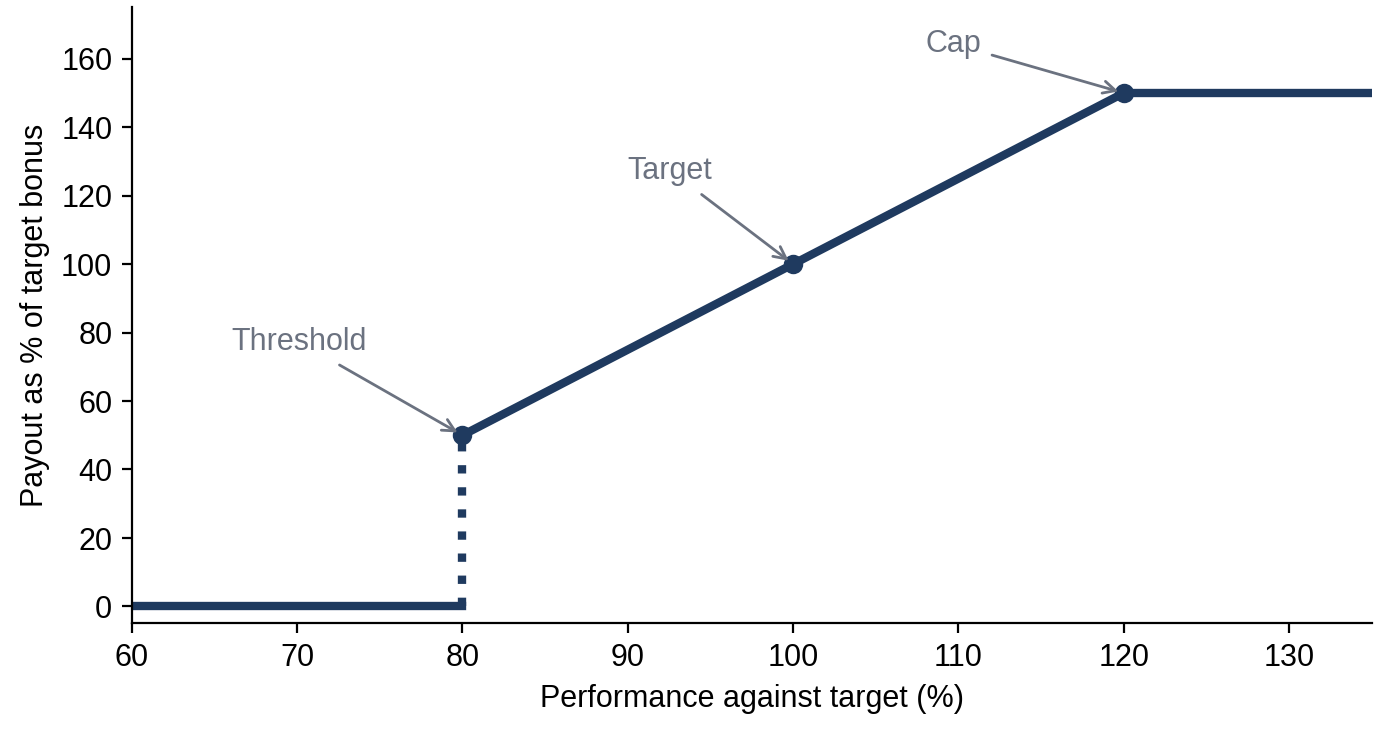
A payout curve sets what is paid at different levels of performance. Most plans use three points: a threshold below which nothing is paid, a target that pays 100% of the bonus, and a cap that limits the upside.

Illustrative bonus payout curve

Illustrative only: no payout below threshold, 100% at target, a cap above stretch

Many plans also include a gateway, such as a minimum profit level or a clean compliance record, that must be met before any bonus is paid.

7. What are the rules?

Agree in writing how leavers, long absences, disciplinary cases and mid-year role changes are treated, when the bonus is paid, and who has discretion to adjust outcomes and on what basis. Discretion is useful, but it should be exercised by a defined group and recorded.

In uncertain conditions, some top executives now prefer a stronger fixed salary to a package weighted heavily towards variable pay. Certainty has a value of its own, and a plan built purely around upside may not be what senior people want. It is worth asking before redesigning the pay mix.

Communicating the plan

Give each eligible employee a one-page summary: their target, the measures and weightings, how the payout curve works and when they will hear the outcome. Share progress during the year, not only at the end. A bonus that arrives as a surprise, good or bad, has taught nobody anything.

Bonus terms can have contractual consequences, particularly around whether payments are discretionary or guaranteed,.

How Humatix can help

Humatix designs and benchmarks short-term incentive plans for UAE and GCC employers, covering target opportunity, funding, measures, payout curves and plan rules, alongside the performance and salary frameworks that support them.

Note: legal or tax advice should be sought on the legal and tax matters referred to in this article, as requirements vary by jurisdiction and change over time.