← Back
Rewards7 min read22 October 2026

Benchmarking Connected Persons Compensation in the UAE: What We Are Seeing

Why UAE owners and directors now need market evidence for their pay, how connected persons benchmarks are used and run, and trends from recent Humatix work.

For many years, what a business owner paid themselves in the UAE was largely a private decision. That has changed. In recent months, Humatix has seen a marked increase in owners and directors asking for independent benchmarks of their own compensation, often well before anyone has asked them to produce one.

This report explains why connected persons benchmarks have become so common, how they are used, how we carry them out, and the main themes emerging from our recent work with owner-managed businesses across sectors including trading, professional services, healthcare, logistics, real estate and industrial services.

Owners and directors increasingly need market data to support decisions about their own pay. Owner compensation must be supported by peer evidence; it can no longer rest on the owner's discretion alone. The owner's role must be clearly defined, because responsibilities, not ownership, determine the right peer group. Pay mix is under scrutiny: fixed pay should measure up to the market, and variable pay should be tied to reasonable metrics. More directors are completing benchmarks proactively, to get ahead of their compliance obligations.

Background: why these benchmarks matter now

Corporate tax and connected persons

The main driver is the UAE Corporate Tax regime, which applies to financial years starting on or after 1 June 2023. Under the regime, payments or benefits that a business provides to a connected person are deductible only to the extent that they correspond to the market value of the service provided.

Connected persons include the owners of a business, its directors and officers, and individuals related to them. In owner-managed companies, that captures exactly the people whose pay has historically been set with the least external reference.

The practical effect is straightforward. If an owner-director's salary and bonus are well above what the market would pay someone in an equivalent role, part of that cost may not be deductible. If the business is asked to support the figure, "this is what the owner decided" is not a market value argument. Independent peer data is.

Wider governance expectations

Tax is not the only pressure. Co-owners want assurance that partners are paid fairly for the work they do. Boards and investment committees expect related-party pay to be approved on evidence. Lenders, investors and buyers look closely at management costs when assessing performance and value. Each of these leads to the same request: show us how this figure compares with the market.

Where connected persons benchmarks are used

ApplicationHow the benchmark helps
Corporate tax supportProvides documented market evidence that connected persons pay reflects market value
Board and shareholder approvalGives directors an independent basis for approving related-party remuneration
Agreements between co-ownersSets fair pay for each partner's working role, separate from their share of profits
Investment, sale or valuationShows whether management costs are realistic, supporting normalised earnings
Succession planningIndicates what it would cost to hire a professional executive into the owner's role
Annual pay decisionsGives owners a reference point when adjusting their own pay year on year

How Humatix performs these benchmarks

How Humatix benchmarks connected persons compensation

Our six-stage approach to connected persons benchmarking

1. Define the role

We start by establishing what the owner or director actually does, through a structured discussion and role questionnaire. Is the role closest to a chief executive, a managing director, an executive chairman or a non-executive director? What decisions does the person take, which functions report to them and how much of their time does the business take?

This step matters more in owner-managed businesses than anywhere else. Titles are often historic or informal, and two co-owners with the same title may carry very different responsibilities.

2. Build the peer group

The peer group reflects the role and the business: industry, size, complexity, ownership structure and location. Where direct industry peers are limited, we widen the group to adjacent sectors or use financial measures such as revenue and headcount to find businesses of comparable scale. For some roles, international comparators are added alongside the local market.

3. Gather market data

Our analysis draws on the Humatix proprietary compensation database, built from previous benchmarking surveys, together with verifiable public sources. Each data point is matched to the defined role, not to a job title alone.

4. Normalise pay elements

Owner pay often arrives in an unusual shape, so we break it into comparable elements: fixed salary and allowances, bonus or variable pay, total cash and key benefits. Returns on capital, such as dividends and profit distributions, are excluded. The benchmark concerns pay for the work performed, not the return on ownership.

5. Analyse and position

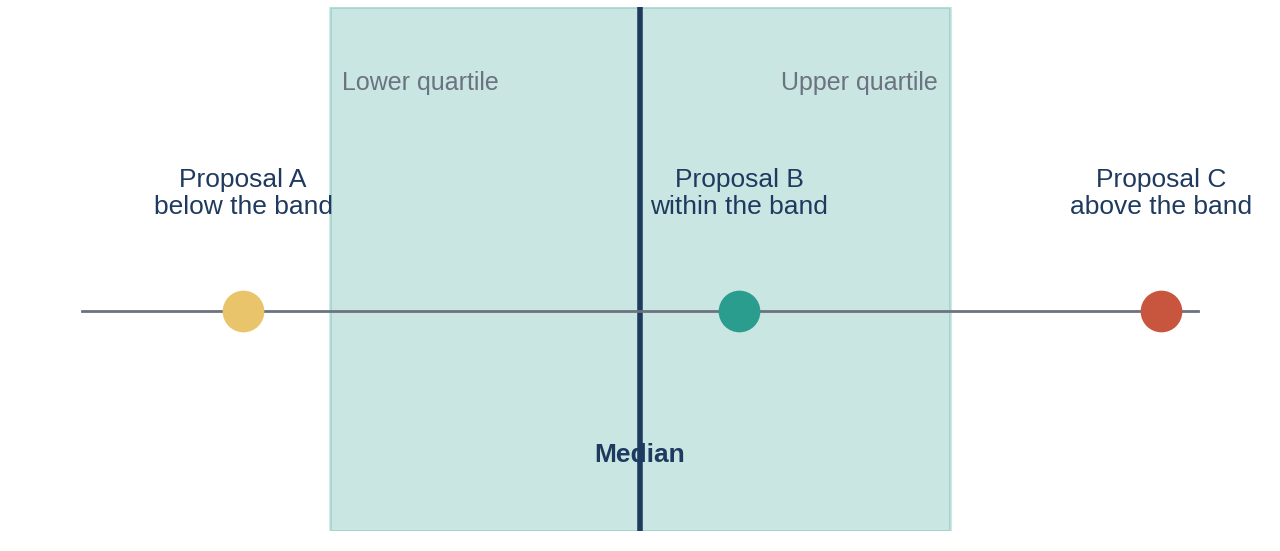
Results are presented as percentiles for each element. The minimum and maximum of a range often represent outliers; most comparable roles sit between the lower and upper quartile, and that band usually provides the most defensible reference point.

Illustrative: testing proposed fixed pay against the peer range

Illustrative only: proposed pay is tested against the peer range for each element

6. Report and document

The final report sets out the role definition, the peer group and the reasoning behind it, the data sources, the findings for each pay element and a clear statement of positioning. It is written to be read by boards, auditors and tax advisers, and to be refreshed when the business or the role changes.

What we are seeing

Market data now underpins owner pay decisions

Owners and directors who once set their pay informally now want a market reference before making the decision, not afterwards. Increasingly, the benchmark is commissioned as part of the annual pay-setting process rather than as a one-off exercise.

Discretion alone is no longer enough

An owner may still have the authority to set their own pay, but authority is not evidence. Where pay is challenged, the question is whether it reflects market value for the role. Peer data, documented with a clear method, answers that question; the owner's judgement on its own does not.

Role clarity determines the peer group

In businesses with several owners, each person's role needs to be defined separately. One co-owner may run the business day to day, another may lead a single function, and a third may be largely non-executive. Benchmarking all three against the same chief executive peer group would overstate the market value for some and understate it for others. Clear role definitions are the foundation of a credible benchmark.

Pay mix is under scrutiny

Our benchmarks increasingly look at the structure of pay, not just the total.

Fixed pay should measure up to the market benchmark for the defined role. We regularly see fixed salaries that vary widely among owners, partly because owners have more discretion over how pay is split and some weight their reward heavily towards variable pay.

Variable pay should be tied to reasonable metrics and KPIs, such as financial results or agreed objectives, rather than being a discretionary distribution under another name. Among firms that formalise variable pay, bonus sizing tends to be more consistent than fixed salary.


ElementWhat a sound position looks likeWhat raises questions
Fixed payWithin the market range for the defined roleWell above the upper quartile with no clear justification
Variable payLinked to defined metrics, with a target and a capLarge, discretionary payments with no stated basis
BenefitsConsistent with policy for comparable rolesPersonal costs paid through the business without a clear policy
DocumentationRole definition, peer group and method recordedFigures with no supporting rationale

Directors are acting early

The clearest trend of recent months is timing. A growing number of directors are commissioning benchmarks proactively, before a filing deadline, an investor process or a query from an adviser makes it urgent. Their aim is to have the evidence in place and their pay structured sensibly, rather than to justify a figure after the event.

Practical steps for owners and directors

  • Write down what each owner and director actually does, including time commitment and decision-making authority.
  • Separate pay for work from returns on ownership in how compensation is paid and recorded.
  • Check fixed pay against a relevant peer group for each defined role.
  • Link variable pay to clear measures, with a defined target and a cap.
  • Document the method and the result, and refresh the benchmark when the role or the business changes significantly.

How Humatix can help

Humatix prepares independent connected persons compensation benchmarks for owners, founders, shareholders and directors of UAE businesses. Each benchmark defines the role, builds a peer group to match it and sets out the findings in a report designed to support board approval and professional review.

Note: legal or tax advice should be sought on the legal and tax matters referred to in this article, as requirements vary by jurisdiction and change over time.