
When a manager asks for a new role, the number in the request is usually the salary. Finance knows the real figure is higher. The difference between the two, the full cost to company, is easy to underestimate and matters for every decision about headcount, pricing and pay.
Rewards3 min read21 October 2026
The True Cost of an Employee in the UAE
What an employee really costs in the UAE: salary, allowances, benefits, visas, end-of-service accrual and overheads, and why it matters for decisions.
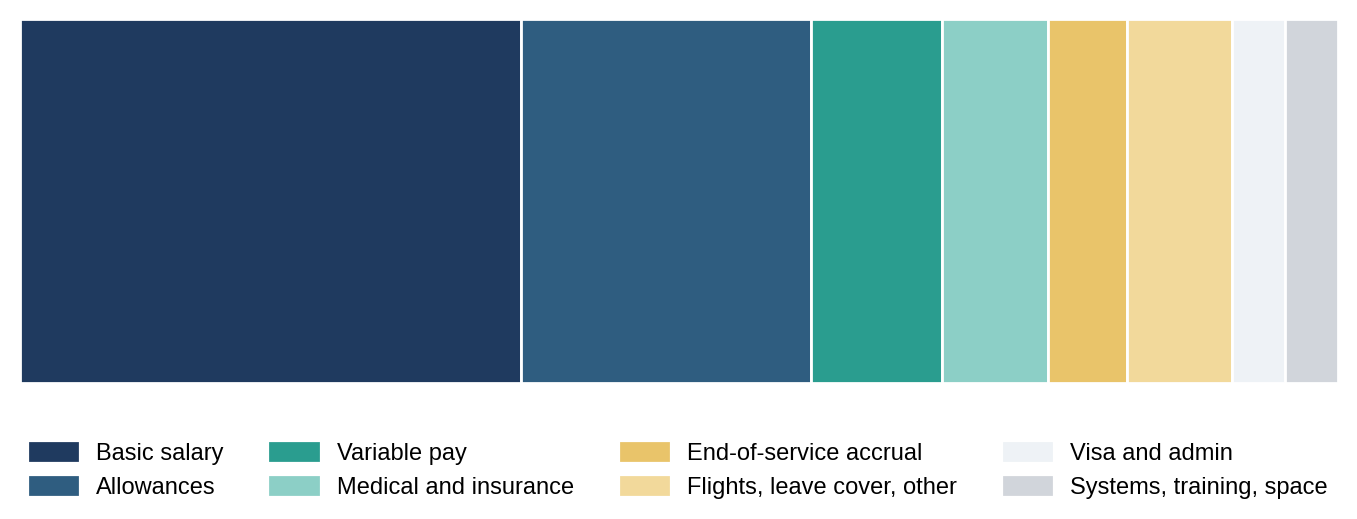
Illustrative make-up of cost to company (proportions vary by role)
| Element | What to include |
|---|---|
| Basic salary | Contractual base pay |
| Allowances | Housing, transport and any other fixed allowances |
| Variable pay | Expected bonus, commission or incentive at target |
| Medical and insurance | Health insurance for the employee and any covered dependants, plus other insurance cover |
| End-of-service | The annual accrual for gratuity, or contributions to an approved savings scheme where applicable |
| Pension contributions | Employer contributions for UAE and GCC nationals where they apply |
| Flights and leave | Annual flight allowances, plus the cost of covering work during leave |
| Visa and administration | Work permit, visa, Emirates ID and related costs, including renewals |
| Equipment and space | Laptop, systems licences, office space and phone |
| Training and development | Budgeted learning spend |
Why it matters
Headcount decisions. A business case built on salary alone understates the cost of a new role. The gap is wider for senior expatriate roles with family benefits.
Comparing options. When deciding between a permanent hire, a contractor or an outsourced service, only cost to company gives a fair comparison.
Pricing and project costing. Professional services firms in particular need accurate employee costs to price work and judge margin.
Pay decisions. An increase to basic salary raises more than monthly pay; it also increases the end-of-service accrual and any payments calculated on basic salary.
For a diversified group, we benchmarked total annual compensation and cost to company for its senior leadership team. Looking at cost to company alongside pay made it clear that two packages with similar headline salaries carried very different total costs once benefits and allowances were included.
A simple way to calculate it
Build a cost to company template by grade, using your own policies for allowances and benefits. For each grade, record the typical basic salary and allowances, the target bonus, the cost of your medical scheme at the typical family status for that level, the annual end-of-service accrual, and standard visa, equipment and overhead costs. Update it after each salary review and benefits renewal.
The template becomes a quick reference for managers requesting headcount and for finance planning the year ahead.
Points to watch
- Count dependants' benefits where your policy provides them; they can be a large share of cost for senior roles.
- Remember that some costs recur on a cycle, such as visa renewals, rather than every year.
- Use expected rather than maximum bonus for planning, but test the maximum for affordability.
- Revisit the template when policies change, not just when salaries do.
How Humatix can help
Humatix benchmarks total compensation and cost to company for UAE and GCC employers, and helps finance and HR teams build cost models that support headcount, pay and pricing decisions.
Note: legal or tax advice should be sought on the legal and tax matters referred to in this article, as requirements vary by jurisdiction and change over time.