
← Back
Employee Experience3 min read21 October 2026

Employee Engagement vs Satisfaction: What Should You Measure?

Employee engagement vs employee satisfaction: what each measures, how they relate, where eNPS fits and how to decide what your next survey should track.

Ask a few managers how engaged their people are and you will get several definitions. For one, it means staff seem happy. For another, it means effort and initiative. A third thinks immediately about who might resign. The ideas overlap, but they are not the same, and mixing them up leads to surveys that measure the wrong thing.

Two different questions

Satisfaction asks whether people are content with their job and its conditions: pay, benefits, hours, workplace, job security, working relationships. In short, does the job meet their needs?

Engagement asks how much energy and commitment people bring to their work and the organisation. Engaged employees understand why their work matters, go beyond the minimum and want the business to succeed.

A useful shorthand: satisfaction is about what the employer provides; engagement is about what employees choose to give back.

How they relate

The two often move together, but not always.
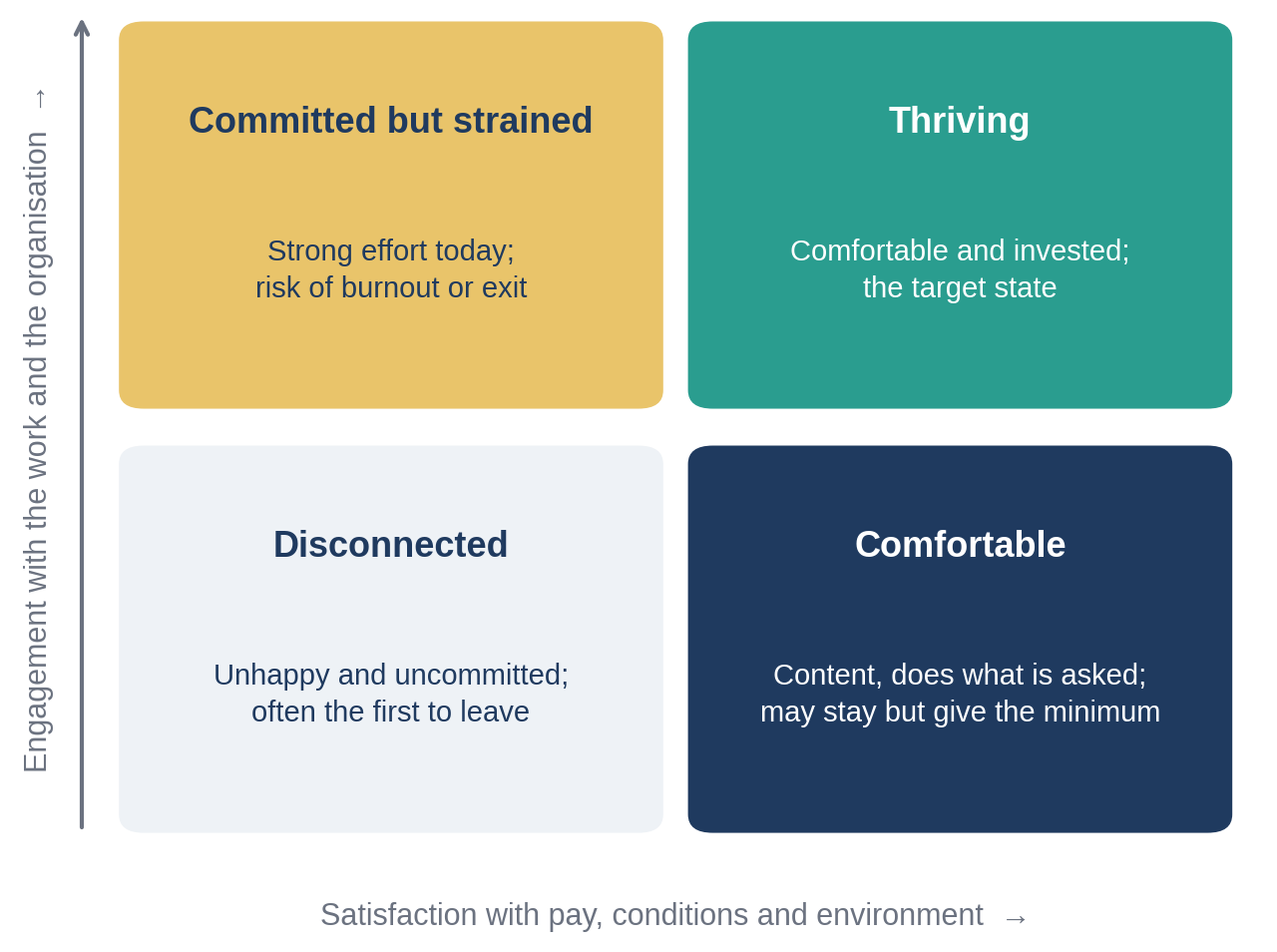
Four profiles a single score can hide

Satisfaction and engagement combine into four distinct profiles

The two mixed profiles explain why one measure alone can mislead. High satisfaction does not guarantee high performance, and high engagement can hide strain that surfaces later as burnout or a resignation.

In practice, satisfaction acts as the foundation. Where basic expectations around fair pay, manageable workload and competent management are not met, efforts to raise engagement ring hollow. Engagement then lifts a steady team into a high-performing one, and depends heavily on the line manager, role clarity, development, recognition and confidence in leadership.

In the UAE, housing, school fees, visa arrangements and family needs can weigh heavily on satisfaction, while a multinational workforce brings different expectations about leadership style and recognition. Questions should reflect those realities rather than rely on generic wording.

Deciding what to measure

Start with the decision the data must support.

If you need to...Measure
Fix specific issues with policy, facilities or rewardSatisfaction items with clear owners (facilities, reward, HR policy)
Understand commitment and the risk of losing strong performersEngagement outcomes plus the drivers behind them
Do bothOne survey with clearly labelled sections, analysed separately
Track sentiment between surveysA short pulse, possibly including eNPS

Where eNPS fits

The employee Net Promoter Score uses one question, usually on a 0–10 scale: how likely are you to recommend this organisation as a place to work? Scores of 9–10 are promoters, 7–8 passives and 0–6 detractors. The score is the percentage of promoters minus the percentage of detractors.

It is quick and works well as a regular pulse. It is not a full measure of engagement, because it tells you whether people would recommend you without telling you why. Use it alongside a fuller survey, not instead of one.

Common mistakes

  • Calling a satisfaction survey an engagement survey, then expecting performance to rise once the issues are fixed
  • Asking so many questions that people rush
  • Reporting scores without analysing what drives them
  • Weak confidentiality, which discourages honest answers
  • Collecting feedback and visibly changing nothing

How Humatix can help

Humatix designs and runs engagement and satisfaction surveys for UAE organisations, including questionnaire design, confidential administration, driver analysis and support for leadership teams in planning the response.