← Back
Talent Management4 min read21 October 2026

How to Build a Competency Framework Managers Will Actually Use

How to build a competency framework for a UAE organisation: choosing competencies, writing observable indicators, setting levels and making it stick.

A competency framework describes what good work looks like in your organisation. It sets out the knowledge, skills and behaviours roles require, and gives managers a shared language for hiring, developing, reviewing and promoting people. Built carefully, it becomes the backbone of other people processes. Built in a hurry, it sits untouched in a shared folder.

The parts of a framework

Most frameworks contain four elements: competencies (named capabilities such as "Financial Analysis" or "Customer Focus"), definitions of what each means in your setting, behavioural indicators that show the competency in action, and proficiency levels showing how the standard rises with seniority. Each role or job family then gets a profile listing the competencies it needs and the level expected.

Technical and behavioural competencies

Technical competencies are the specialist knowledge and skills a function relies on: processing payroll, managing contracts, building financial models. They differ between job families and are maintained by subject experts, often updated as systems and regulation change.

Behavioural competencies describe how people work: communicating, collaborating, solving problems, adapting, taking ownership. They usually apply across the organisation, with the bar rising at each level, and are reviewed every few years.

A leadership set either sits within the behavioural competencies or forms an extra layer for people leaders: setting direction, developing others, deciding under uncertainty, shaping culture.
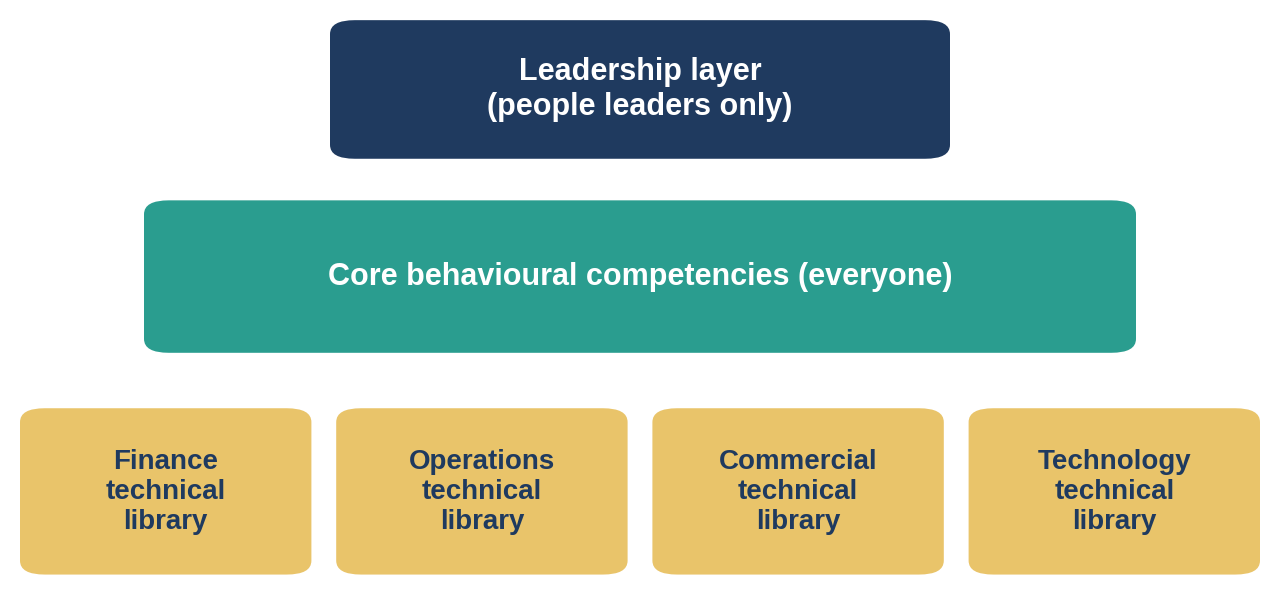
A layered competency model

One common structure: core behaviours for all, a leadership layer, and technical libraries by function

Eight steps

1. Decide what it is for

Hiring, appraisal, learning, succession and job evaluation can all use the framework, but each pulls the design slightly differently. Selection needs crisp, observable indicators. Development benefits from more detail on how to move from one level to the next.

2. Connect it to strategy and values

A company expanding across the region might emphasise cross-cultural working and stakeholder management. One digitising its operations might prioritise data literacy and openness to change. Include your stated values, or the framework will work against the culture you want.

3. Find out what good looks like here

Interview senior leaders, run focus groups with strong performers and their managers, and review job descriptions and appraisal records. Ask what genuinely separates excellent work from acceptable work.

4. Keep it short

A small set of core behavioural competencies is far easier to remember and use than a long catalogue. Merge related ideas and check each competency is distinct.

5. Write indicators people can observe

"Has excellent communication skills" gives a manager little to work with. "Adjusts the level of detail in written updates to the reader" is something they can look for. Avoid wording that favours one cultural communication style: "speaks up assertively in meetings" may penalise capable colleagues whose norms differ. Where teams work in Arabic and English, check each indicator carries the same meaning in both.

6. Set proficiency levels

Take an illustrative "Problem Solving" competency. At entry level, the person resolves routine issues using established methods. At middle level, they identify root causes across the team's work. At the highest level, they anticipate organisation-wide risks and lead the response. Where possible, align the number of levels with your grading structure.

7. Test it

Ask a handful of managers to build profiles for real roles and rate a few employees. Wherever they disagree, or struggle to tell two levels apart, the wording needs work. Fixing it now is far easier than after launch.

8. Launch and maintain

Introduce the framework with guidance and manager training, and build it into role profiles, interview guides, appraisal forms and learning plans. Appoint an owner and set a review cycle.

Traps to avoid

  • Adopting a ready-made framework unchanged
  • Indicators too vague to observe
  • More competencies than anyone can remember
  • Building it inside HR without line manager input
  • Launching it without linking it to real processes

How Humatix can help

Humatix supports organisations from initial research and drafting through to proficiency levels, role mapping and rollout, and connects the framework to grading, assessment and succession so managers use one language throughout.