
← Back
Organisational Design4 min read21 October 2026

Job Families and Career Levels: Building a Job Levelling Framework

How UAE HR teams can group roles into job families, define career levels, rationalise titles and link levels to grades with a job levelling framework.

When a company grows quickly, job titles multiply faster than anyone can manage them. A business that started with ten roles can find itself a few years later with forty titles that overlap, contradict each other or mean different things in different departments. The same job is "Specialist" in one team and "Senior Analyst" in another, and nobody can say what it takes to be promoted.

A job levelling framework fixes this by placing every role on two axes: the type of work it involves, and the size of its contribution.

Two axes, one map

Job family describes the type of work: finance, commercial, operations, technology, HR. Career level describes the breadth and difficulty of the contribution, from entry-level roles to senior leadership. Put the two together and each role has a single position on a map.
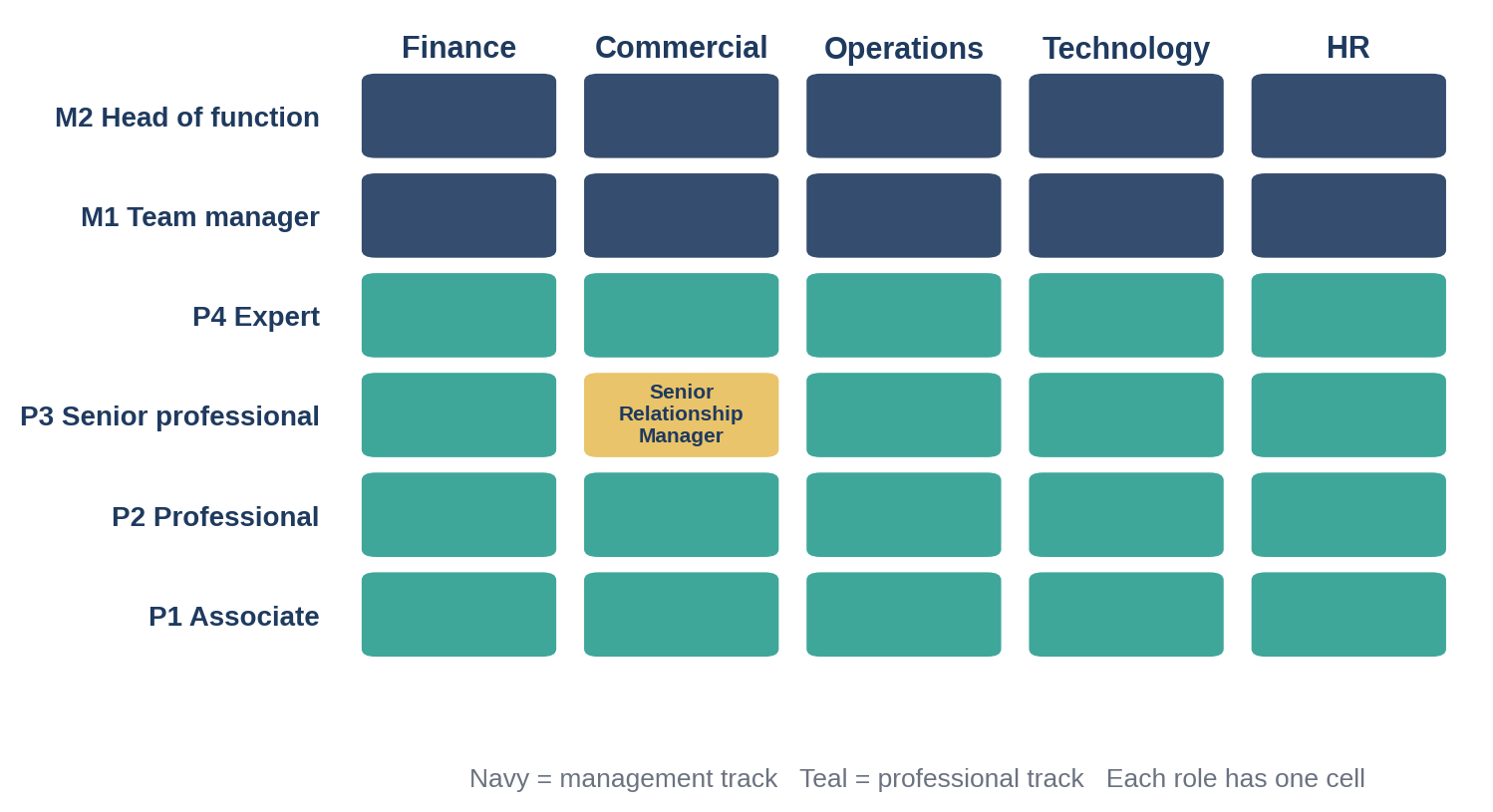
An illustrative grid of job families and career levels, with separate management and professional tracks

Levels and grades are related but different. A level describes scope and expectations. A grade, normally set through job evaluation, carries the pay range. Most employers align them so that each level maps to one grade or a narrow band of grades.

Why it matters in the UAE

New hires come from dozens of countries with their own ideas of what "manager" or "director" means, so defined levels make offers easier to explain. Benchmarking needs consistent levels to match roles properly. Employers developing UAE nationals find career paths easier to plan and demonstrate when they are visible. And groups operating across mainland and free zone entities need one structure so that like can be compared with like.

Building the framework

Families

A family groups roles that share a type of work, a broad skill set and a likely career path. Large families can be split into sub-families: finance might contain accounting, financial planning and treasury. Aim for enough families to be meaningful but not so many that maintenance becomes a burden.

Levels

Most employers write one set of generic level descriptors that applies across every family. Each descriptor typically covers depth of knowledge, complexity of problems, degree of autonomy, breadth of impact and whether the role leads people.

At senior levels, many organisations split into a management track and a professional track. A strong engineer or analyst can then keep progressing without having to manage a large team.

Pay steps between levels are steepest at the top of the organisation, and the share of pay that is variable rises with each step up. Levels should therefore shape both the size of pay steps and how much of the package is at risk.

Source: Humatix analysis of our proprietary compensation database, built from previous benchmarking surveys, and verifiable public sources.

Eight steps

  • Gather role information: job descriptions, organisation charts and headcount by role. Fill gaps by talking to line managers.
  • Agree the families and test them with function heads.
  • Write level descriptors, making sure adjacent levels are clearly distinct.
  • Place each role by what the job requires, not by the current title or the holder's salary.
  • Rationalise titles so the same title means the same level everywhere.
  • Link levels to grades through job evaluation, and grades to pay ranges.
  • Calibrate and approve placements across functions with leadership.
  • Roll out and maintain, with a clear process for placing new or changed roles.

One local point: job titles can appear on employment contracts, work permits and visas. Before renaming roles in bulk, check whether official records need updating.

A worked example

A regional distribution business has grown its customer-facing team quickly. Across its offices, "Client Lead", "Sales Coordinator", "Business Development Executive", "Relationship Officer" and "Senior Sales Associate" describe heavily overlapping roles. HR creates a Commercial family with two sub-families, Client Relationships and Sales, and leadership approves the levels below.

LevelTitle conventionExpectation
P1AssociateManages defined accounts with close guidance
P2Relationship ManagerHandles a portfolio without daily supervision
P3Senior Relationship ManagerManages complex accounts and coaches peers
P4PrincipalOwns strategic accounts and shapes commercial direction
M1Team ManagerLeads one sales or client team
M2Head of CommercialLeads the commercial function

Two roles that did identical work under different names now share one title and one level.

What usually goes wrong

  • Levelling the person rather than the job
  • Letting current salaries decide a role's level
  • Descriptors so vague that adjacent levels blur
  • More levels than the organisation needs
  • Launching without explaining what changes for employees
  • Nobody owning the framework once it is live

How Humatix can help

Humatix provides job evaluation and grading for UAE employers, defining job families and career levels, linking levels to grades and pay ranges, facilitating calibration with leadership and planning how changes are explained to employees.

Note: legal or tax advice should be sought on the legal and tax matters referred to in this article, as requirements vary by jurisdiction and change over time.