
← Back
Employee Experience3 min read21 October 2026

Pulse Surveys: When They Help and When They Become Noise

Pulse surveys can keep engagement work on track or become background noise. How to decide frequency, choose questions and make each pulse lead to action.

Short, frequent surveys have become popular as a way to keep track of how employees feel between annual surveys. Used well, they show whether actions are working and catch problems early. Used badly, they turn into a stream of questions that nobody acts on, and employees stop answering.

The difference is almost always in the purpose, not the tool.

What a pulse is for

A pulse survey is a short check, usually five to ten questions, run between fuller surveys. It is best used to:

  • track progress on the priorities chosen after the annual survey
  • check how people are coping during a period of change
  • test reaction to a new policy or way of working
  • keep a small set of key indicators visible to leaders

It is not a substitute for a full survey. A handful of questions cannot explain why engagement is moving.
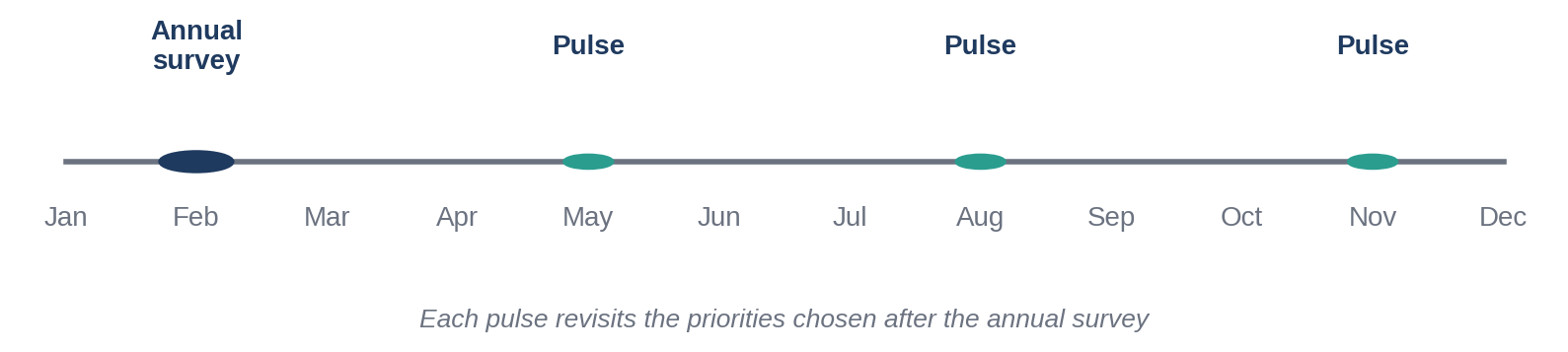
One full survey, a few short pulses

One common rhythm: an annual survey followed by a small number of targeted pulses

How often?

More frequent is not better. Each pulse needs time for results to be shared and for something to happen before the next one. For most organisations, quarterly pulses are plenty; monthly pulses work only where there is a team ready to act on every round.

A useful rule: if you cannot point to something that changed since the last pulse, do not run the next one yet.

Choosing the questions

Keep a small fixed core, so results can be compared over time, and a few rotating questions linked to current priorities.

TypeExamples
Fixed coreI would recommend this organisation as a place to work. / I see myself here in two years' time. / My manager supports me to do my best work.
Priority trackingI have seen action on the issues raised in our last survey. / Communication about changes in my area has improved.
TopicalI understand the reasons for the recent restructure. / The new working pattern is working well for my team.

Making each pulse count

Share results quickly. Within a couple of weeks, with a short note on what was heard.

Report by team where possible. Respecting minimum group sizes so nobody can be identified.

Link back to actions. Show what has changed since the last round, even if it is small.

Let managers own it. Team-level results are most useful when the manager discusses them with the team.

Signs your pulse programme needs a rethink

  • Response rates are falling with each round.
  • Leaders look at the dashboard but no actions follow.
  • The same issues appear in every pulse with no change.
  • Employees say they are surveyed too often.

When these appear, pause, reduce the frequency and focus on showing action on what has already been said.

How Humatix can help

Humatix designs and runs engagement surveys and pulse programmes for UAE employers, with question sets, reporting and action planning built around the decisions leaders need to make.