
← Back
Rewards6 min read21 October 2026

How Salary Benchmarking Works: A Step-by-Step Guide for UAE Employers

How salary benchmarking works for UAE employers: choosing a peer group, matching jobs on content, reading percentiles, ageing data and governing decisions.

Pay decisions are among the most visible an employer makes. Pay too little and good candidates decline while current staff start looking. Pay too much and the wage bill grows with nothing to show for it. Salary benchmarking puts those decisions on firmer ground by comparing what you pay with what similar organisations pay for similar work.

This guide walks through the method from start to sign-off.

Why it matters more in the UAE

Three features of the local market make good data especially valuable. Employers compete for talent with organisations across the Gulf and beyond. The workforce is highly international, and candidates often compare offers from several countries at once. And packages are built very differently, with housing, transport and other allowances added to basic salary in widely varying proportions.

Without reliable data, pay tends to follow the latest offer, a candidate's request or instinct. Over time, people in similar roles end up on noticeably different pay for reasons nobody can explain.

The six stages

Six stages of a benchmarking cycle

A benchmarking cycle you can repeat each year

1. Agree the purpose and scope

Be clear about why you are benchmarking: building pay ranges, preparing an annual review, pricing a new role, or checking competitiveness in a job family that is hard to fill. Then choose the roles. Many employers start with a representative set of benchmark jobs rather than every position.

2. Choose your comparator market

The comparator market is the group of organisations you compete with for people, defined by some mix of industry, size and location. A mid-sized Dubai software company might compare engineering roles with technology firms of a similar size, but use a broader cross-sector market for finance and HR roles.

This decision shapes every number that follows.

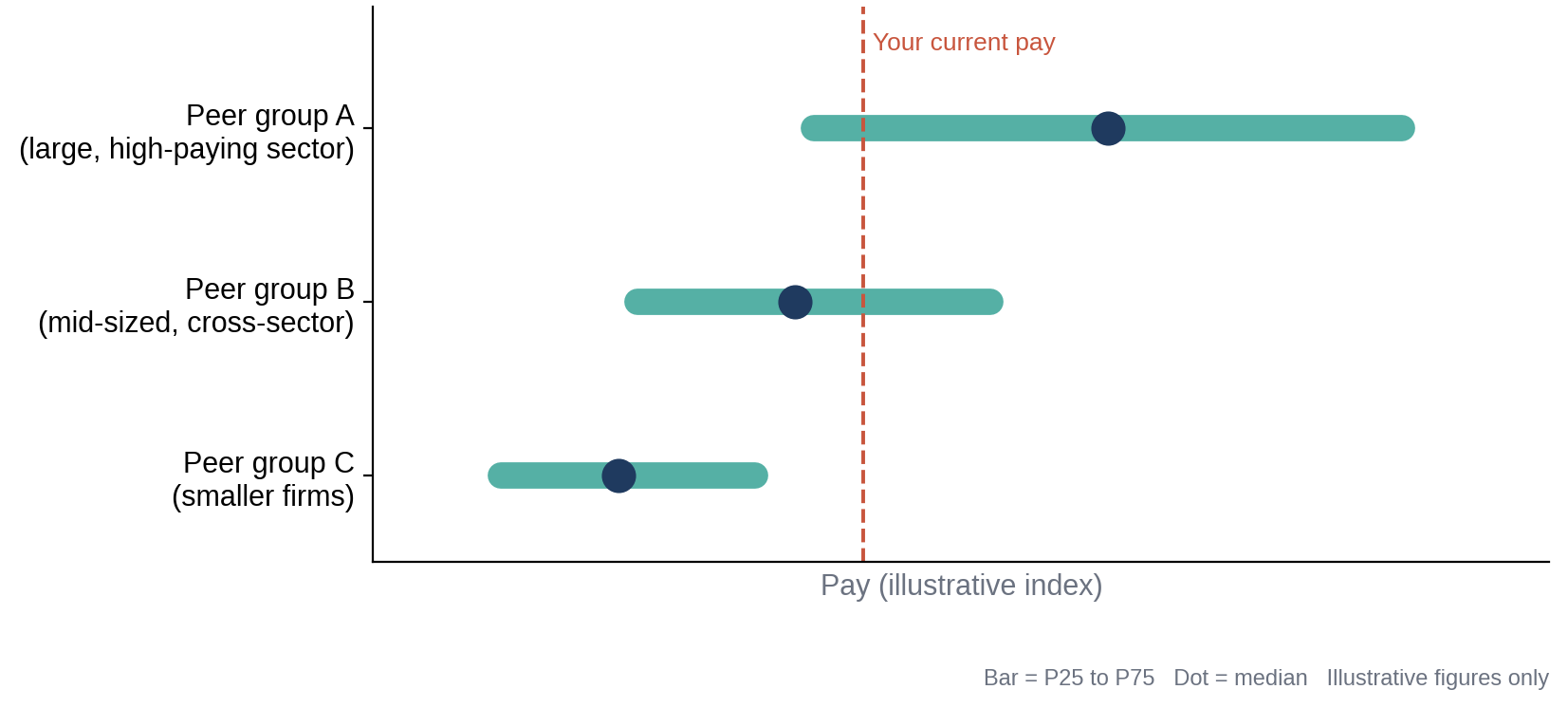
Pay for the same senior title varies widely with company size and sector. In our experience, the choice of peer group can move the answer as much as any other decision in the process, which is why it deserves explicit agreement from leadership before any data is pulled.

Source: Humatix analysis of our proprietary compensation database, built from previous benchmarking surveys, and verifiable public sources.

Same role, three peer groups, three different answers

Illustrative only: the same role benchmarked against three different peer groups

A shift we are seeing in recent work: some clients are less interested in broad survey data drawn from thousands of data points loosely aligned with their industry, and more interested in a focused study of ten to fifteen direct peers or competitors. A tight peer set answers the question leadership is actually asking, which is how they compare with the companies they compete against. Broad data still has its place for common roles, but for senior and specialist positions the focused approach is often more persuasive.

We benchmarked board remuneration for a listed company in the region, covering board, committee and attendance fees and any performance-linked elements. Comparing against two reference points, local listed peers and established international practice, let the board see both where it stood locally and how its structure compared with wider governance norms.

3. Match jobs on content, not title

This is the step most often rushed. A "manager" in one company runs a large department; in another, the same title belongs to a senior individual contributor. Compare purpose, responsibilities, scope, reporting line and level. Matching is much more reliable when your roles already sit within a consistent grading or levelling framework.

4. Choose and test your data sources

Options include published surveys, consultancy databases, a bespoke survey with peers, or a benchmarking platform. Before relying on any of them, ask how the data was collected and from how many organisations, whether participants resemble your comparator market, how jobs are described and levelled, how pay is broken down, and when it was gathered. Two or more sources add confidence, provided their job definitions are compatible.

5. Compare like with like

Make sure every comparison uses the same pay definition.

DefinitionUsually includes
Basic salaryContractual base pay only
Fixed cashBasic salary plus guaranteed allowances such as housing and transport
Total cashFixed cash plus actual or target bonus
Total remunerationTotal cash plus benefits and long-term incentives

With UAE packages structured so differently, mixing definitions by accident is easy, and it can distort the findings badly.

6. Turn findings into decisions

Compare each role with the market and choose a response: adjust ranges, prioritise certain roles in the next review, or confirm that pay is about right. Write down the reasoning so it can be explained later.

Reading percentiles

Benchmark results are usually shown as percentiles.

PercentileMeaning
P25 (lower quartile)A quarter of the market is paid at or below this level
P50 (median)The midpoint; often treated as the "market rate"
P75 (upper quartile)Three quarters of the market is paid at or below this level
P90Roughly one in ten is paid above this level

Where you aim is a policy choice. Some employers target the median and go higher for scarce skills. Others hold fixed pay near the median and reward strong performers through variable pay. Neither is right by default; strategy and affordability should decide. Be cautious where a percentile rests on a small number of data points, as it can move sharply from one survey to the next.

Bringing data up to date

Survey data reflects the market on a collection date, but you will use it months later. Ageing moves the figures forward to the date your decisions take effect, using a reasonable estimate of how pay in your sector has moved. Write that assumption down. Where data is badly out of date, replace it rather than stretching it with a large adjustment.

Governance

  • Document the comparator market, data sources and job matches.
  • Have the matches reviewed by someone who knows the roles.
  • Agree the target market position with leadership.
  • Keep the method consistent year to year so results can be compared.
  • Treat pay data as confidential personal data and store it securely.

Common mistakes

  • Matching jobs by title instead of content
  • Comparing basic salary from one source with total package from another
  • Choosing a peer group because it flatters current pay
  • Relying on one small or out-of-date source
  • Making the median the target for every role regardless of strategy

How Humatix can help

Humatix runs benchmarking studies for UAE and GCC employers, from defining the comparator market and matching jobs to analysis and pay structure recommendations, drawing on our proprietary compensation database and verifiable public sources.