← Back
Rewards4 min read21 October 2026

Designing Salary Structures and Pay Ranges That Hold Up

How to design a salary structure: setting grade midpoints, range widths and overlap, using compa-ratios, and handling the basic salary and allowance split.

Benchmarking tells you what the market pays. A salary structure turns that information into rules you can apply every day: what to offer a new hire, how far someone can progress in their role, and when a pay conversation should become a promotion conversation.

Without a structure, every offer and every increase is a fresh negotiation. With one, managers have boundaries, employees can see how pay works, and HR can explain decisions.

The building blocks

A salary structure is a set of grades, each with a pay range. Every range has three reference points.

TermMeaning
MinimumThe lowest pay for a fully competent hire in the grade; new or developing staff may sit near it
MidpointThe reference rate for a fully competent person in the role, usually anchored to your target market position
MaximumThe ceiling for the grade; beyond it, further growth should come through promotion or variable pay
Range spreadThe distance from minimum to maximum, expressed as a percentage of the minimum
Midpoint progressionThe step between one grade's midpoint and the next
OverlapHow much adjacent ranges share; some overlap lets experienced staff in one grade earn more than newcomers in the next

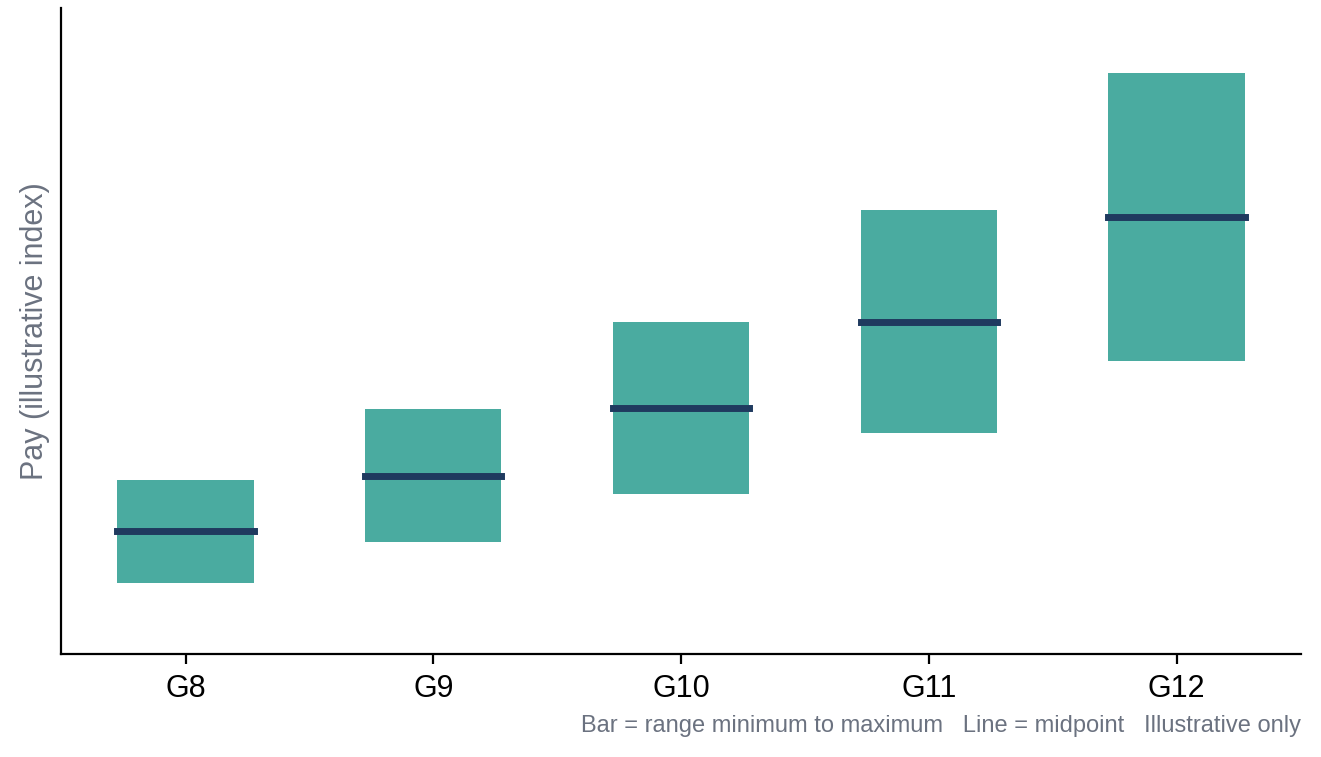
Illustrative salary structure: ranges widen and overlap

Illustrative only: ranges usually widen and steps grow larger towards the top of the structure

Six design decisions

1. Anchor the midpoints. Set each grade's midpoint against your agreed market position for the jobs in it, typically the median of your comparator market, adjusted for policy. If you lead the market for scarce skills, consider a separate range for that job family rather than lifting the whole structure.

2. Choose range widths. Narrow ranges suit junior, well-defined roles where people reach full competence quickly. Wider ranges suit senior roles where experience and contribution vary more. Many structures widen gradually from bottom to top.

3. Set midpoint steps. Steps that are too small make promotion feel meaningless. Steps that are too large create pressure to promote early. Steps usually grow larger towards the top of the organisation, where the gap in responsibility between levels is greatest.

4. Decide on overlap. Some overlap is healthy. Too much, and a senior person in one grade can earn more than a manager two grades up, which is hard to explain.

5. Define fixed pay clearly. In the UAE, decide whether ranges cover basic salary only or fixed cash including allowances. Many employers manage ranges on fixed cash for competitiveness, while keeping a defined split between basic salary and allowances. Because end-of-service gratuity is calculated on basic salary, that split affects both cost and entitlements, so set it deliberately and apply it consistently.

6. Plan for exceptions. Hot skills, legacy salaries and Emiratisation priorities will all test the structure. Agree in advance how exceptions are approved and recorded.

On a recent project, we developed job descriptions and a job evaluation method, built a grading structure aligned to the organisation's role families, and set market-based salary ranges for each grade. A gap analysis against current pay then showed leadership exactly where internal equity and grade consistency needed attention before the new structure was applied.

Using compa-ratios

The compa-ratio is an employee's salary divided by the midpoint of their range. It shows at a glance where each person sits.

Compa-ratioPositionTypical reading
Below 0.85Low in rangeNew to the role, still developing, or underpaid relative to contribution
0.85 to 1.05Around midpointFully competent and paid in line with policy
Above 1.05High in rangeHighly experienced, a strong performer, or a legacy salary to review
Above the range maximumRed-circledPay above the range; increases usually limited until the range catches up

Compa-ratios become most useful in the annual review. A merit matrix that gives larger increases to strong performers low in their range, and smaller ones to people already near the top, moves pay towards the policy position over time without large one-off corrections.

Rolling it out

Before going live, place every employee in the new structure and model the cost. Some people will fall below their new minimum; most employers bring them up over one or two review cycles. Others will sit above the maximum; their pay is usually protected, with future increases limited or paid as a lump sum.

Then explain it. Employees do not need to see everyone's salary, but they should know their grade, their range and how they can move through it.

Keeping it current

A structure is only as good as the market data behind it. Review midpoints each year against updated benchmarks, move the whole structure when the market moves, and re-evaluate roles whose content has changed.

How Humatix can help

Humatix designs salary structures for UAE and GCC employers, from job evaluation and benchmarking through range design, cost modelling and implementation, using our proprietary compensation database and verifiable public sources.

Note: legal or tax advice should be sought on the legal and tax matters referred to in this article, as requirements vary by jurisdiction and change over time.