
← Back
Rewards4 min read21 October 2026

Designing Sales Incentives That Reward the Right Results

How to design a sales incentive plan: setting the pay mix, quotas, thresholds, accelerators and caps, and avoiding plans that reward the wrong behaviour.

Sales teams respond quickly to how they are paid. That is the point of a sales incentive, and also its risk. A plan that pays for volume will get volume, including discounted deals, rushed contracts and customers who leave after a year. A plan that is too complicated to explain will be ignored.

Good sales incentive design starts with a plain question: which results do we want more of, and what are we prepared to pay for them?

Start with the role, not the plan

Not everyone in a commercial team should be on the same plan. A hunter winning new accounts, an account manager growing existing clients and a pre-sales specialist supporting both influence results in different ways. Their incentives should reflect that.
Role typeWhat they controlTypical incentive focus
New businessWinning new clients and contractsNew revenue or contract value, sometimes margin
Account managementRetention and growth of existing accountsRevenue growth, renewals, client retention
Sales support and pre-salesQuality and speed of support to the sales teamTeam results, plus a few individual objectives
Sales leadershipTeam performance and pipeline healthTeam revenue, margin and development of the team

Five design decisions

1. The pay mix

The pay mix is the split between fixed pay and target incentive. Roles with direct control over closing deals can carry a larger variable share. Roles with longer sales cycles, or heavy reliance on others, usually need more fixed pay. In the UAE, where packages already include significant allowances, check that the total fixed element is competitive before deciding how much to put at risk.

2. Quotas

Quotas should be demanding but achievable for a capable person in that territory or segment. If most of the team misses quota every year, the plan stops motivating anyone. If most beat it easily, you are overpaying. Set quotas using pipeline data and account potential, not just last year plus a percentage.

3. The payout curve

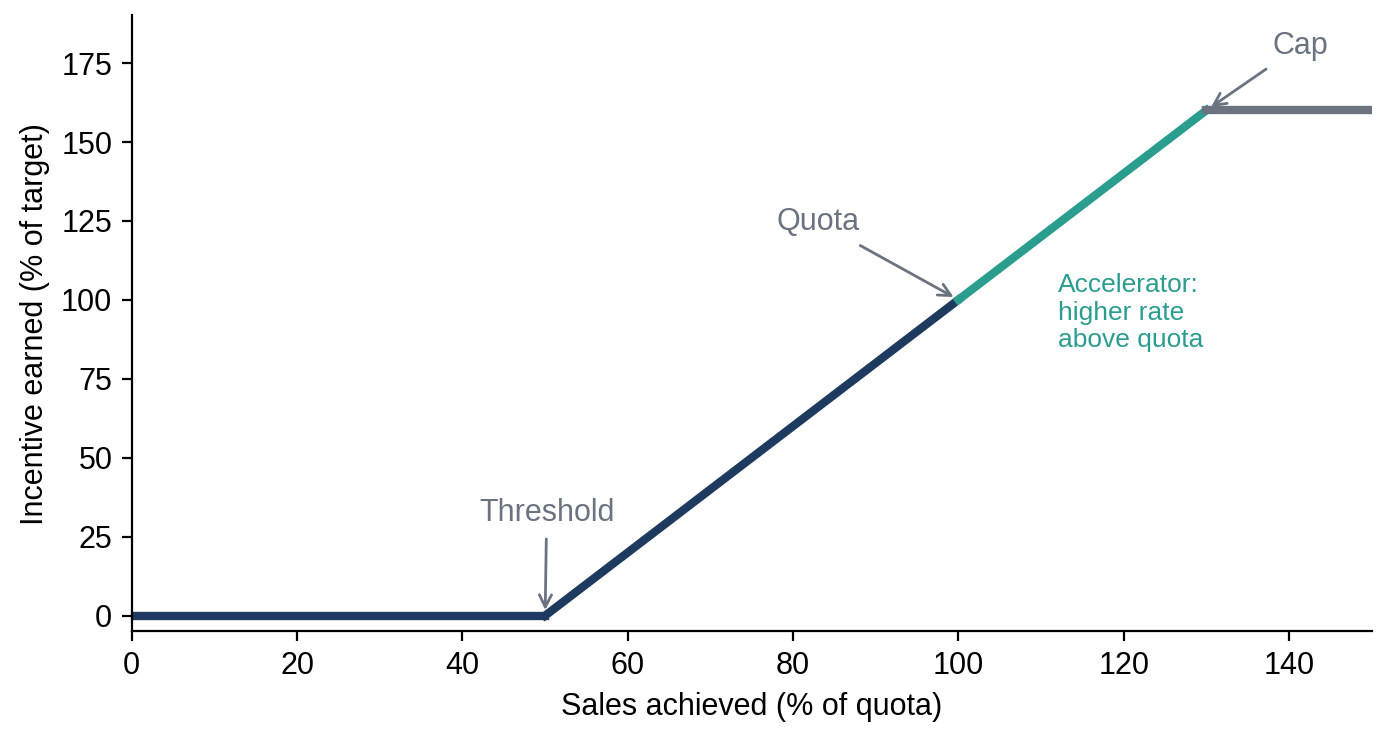
Illustrative sales incentive curve

Illustrative only: a threshold, full payout at quota, faster earnings above it, and a cap

A threshold stops the plan paying for weak performance. An accelerator, a higher rate above quota, rewards exceptional results. A cap limits exposure to windfalls, such as a single very large deal that owes more to timing than effort. Some employers prefer a review mechanism for exceptional deals rather than a hard cap.

4. Measures

Revenue is the obvious measure, but on its own it can encourage discounting. Many plans add a margin or collection element, so that deals only pay out fully when they are profitable and the customer has paid. Keep to two or three measures. Each extra measure dilutes the others.

5. Timing and rules

Monthly or quarterly payouts keep the link between effort and reward short. Annual elements suit larger, longer-term deals. The rules must cover returns, cancellations and unpaid invoices, territory changes, leavers and new joiners, and any clawback of commission already paid.

What we see go wrong

In a recent review of fixed pay and sales incentives for a client's sales professionals, the plan itself was reasonable on paper. The difficulty was that fixed pay had drifted below market, so the incentive was being used to make up the gap rather than to reward strong results. Fixing the fixed pay first made the incentive meaningful again.

Other common problems:

  • Too many measures, so nobody knows what really drives their payout.
  • Quotas set top-down without reference to territory potential.
  • No margin control, leading to discount-driven deals.
  • Unclear treatment of shared deals, causing disputes within the team.
  • Plans changed mid-year without explanation, which damages trust quickly.

Communicate it on one page

Every salesperson should be able to answer three questions: what am I measured on, how much can I earn at quota, and how does it change above and below quota? A one-page plan document with a worked example answers all three. Share regular statements during the year so that people can see where they stand.

How Humatix can help

Humatix designs and benchmarks sales incentive plans for UAE and GCC employers, covering pay mix, quota setting, payout curves and plan rules, alongside the fixed pay benchmarking that sits underneath them.

Note: legal or tax advice should be sought on the legal and tax matters referred to in this article, as requirements vary by jurisdiction and change over time.