← Back
Rewards5 min read21 October 2026

Total Rewards vs Compensation and Benefits: What UAE Employers Should Know

Total rewards vs compensation and benefits: what each covers, why pay alone rarely keeps people, and how UAE employers can make the full offer visible.

When a valued employee resigns, the first assumption is usually that someone offered more money. Sometimes that is true. Often, pay is only part of the story. People also leave when they cannot see their next step, when they doubt that decisions about them are fair, or when they no longer feel they belong.

That is why the difference between total rewards and compensation and benefits is a practical question rather than an academic one.

The short answer

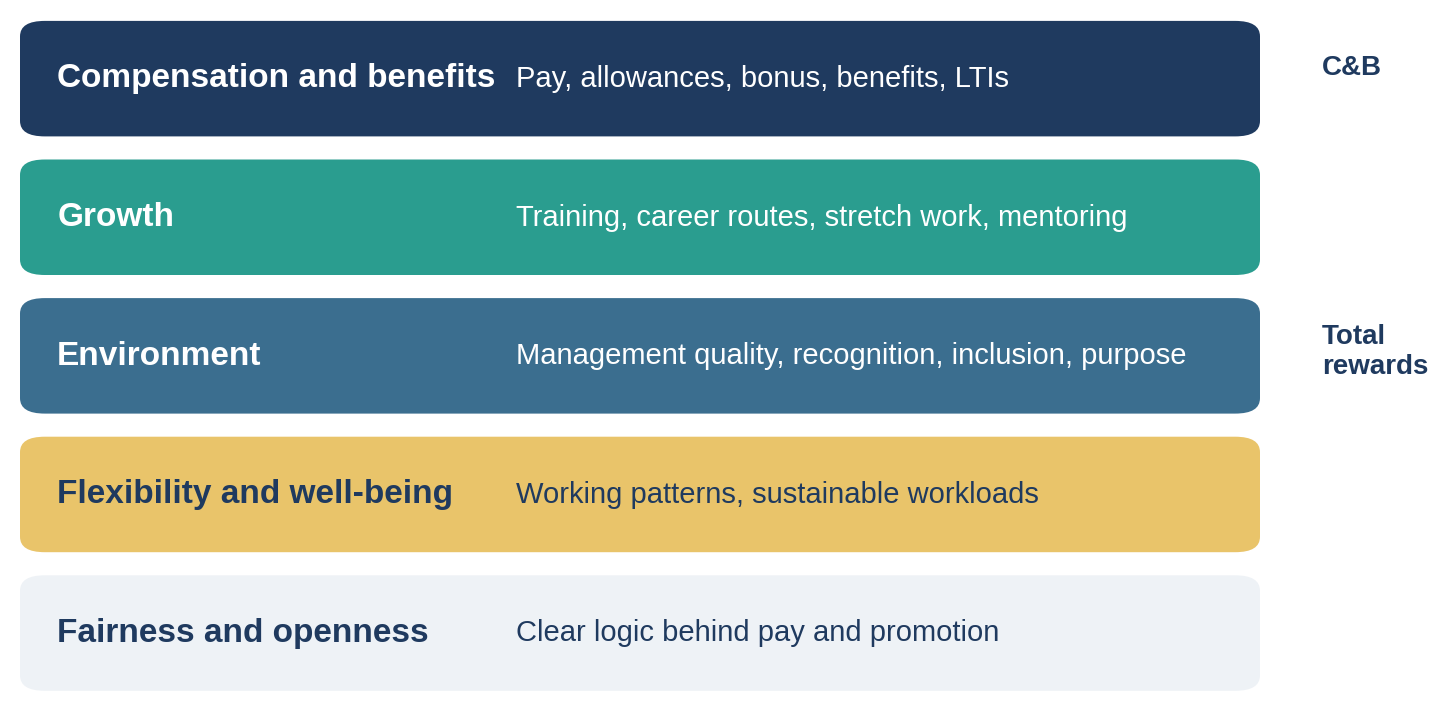
Compensation and benefits is the financial and tangible part of the deal: base salary, allowances, bonuses and commission, benefits such as medical insurance, flights and education support, and long-term incentives where they exist. Statutory entitlements such as end-of-service benefits sit here too.

Total rewards includes all of that and adds the parts people experience but rarely put a price on: growth, the working environment, flexibility, and whether the rules behind pay and promotion are fair and understood.

So it is not a choice between the two. Compensation and benefits sits inside total rewards.

Compensation and benefits sit inside total rewards

Compensation and benefits is one layer of a wider total rewards offer

Where the money actually sits

Executive packages in the UAE are weighted heavily towards fixed pay. Variable pay forms a noticeably larger share at CEO level than in other senior roles, but even there, salary and allowances make up most of the package.

Source: Humatix analysis of our proprietary compensation database, built from previous benchmarking surveys, and verifiable public sources.

Two practical points follow. First, because fixed pay carries so much weight, it deserves the most care: grading, ranges and the split between basic salary and allowances. Second, where variable pay exists, clear and credible criteria matter more than the size of the bonus pot.

Keep your philosophy in charge of the data

A pattern we see in recent work: some employers become so focused on benchmark data that it starts to override their own reward philosophy and the frameworks they already have. Every role gets pulled towards the median, whatever the business intended. Market data should inform your philosophy, not replace it. If your stated aim is to pay above market for scarce skills and at market elsewhere, the benchmark tells you where those lines fall; it should not quietly rewrite the policy.

Why pay alone rarely settles it

Pay is the floor. Fall well below the market and even an excellent culture may not compensate. Once pay is competitive, the non-financial parts of the offer often decide whether someone stays.

Consider two colleagues who each receive a modest offer from a competitor. One declines: their manager supports their development, the next step is visible and they trust that pay is managed fairly. The other accepts because, on similar pay, they feel stuck. The financial offer was identical. Everything around it was not.

The UAE market sharpens this in three ways. Many employees have already moved country at least once and would do so again. When pay is split across several allowances, people can struggle to see its full value. And priorities differ by life stage and background: housing or school fees matter most to some, development or flexible hours to others.

Check the pay base

A broad total rewards approach still depends on pay that is fair and competitive. Benchmark against the organisations you hire from and lose people to, match roles on content rather than title, agree a written position against the market for each job family, and refresh the data regularly. Our guide to salary benchmarking sets out the steps.

Make the whole offer visible

Employees do not need to see colleagues' salaries, but they value knowing how their role is graded, what drives increases and bonuses, what they need to show to progress, and what their full package is worth.

A yearly total rewards statement does much of this on a single page. A simple version might look like this.

ElementShown as
Basic salaryAnnual amount
Housing, transport and other allowancesAnnual amount, listed separately
Annual bonus (paid last year)Amount and the basis on which it was decided
Medical insurance and other benefitsEmployer cost or a clear description
Annual flights, education supportAnnual value where applicable
Learning and developmentSpend on the individual in the year
End-of-service accrualBrief explanation of how it is calculated

Ten questions for your rewards offer

  • Is salary benchmarked against a relevant market, guided by a written positioning policy?
  • Are allowances and benefits easy to follow and consistent for similar roles?
  • Are bonus criteria transparent and linked to things employees can influence?
  • Can each person see their next step, or the one after?
  • Does development have a budget and a process people use?
  • Do managers recognise good work often and fairly?
  • Do working arrangements suit each role and hold up over time?
  • Could employees explain how pay and promotions are decided?
  • Has everyone received a plain statement of their total rewards?
  • Do engagement and exit findings shape what you invest in?

How Humatix can help

Humatix supports UAE employers with rewards consulting and salary benchmarking, including job matching, pay positioning, package design and communicating rewards to employees.

Note: legal or tax advice should be sought on the legal and tax matters referred to in this article, as requirements vary by jurisdiction and change over time.

Total Rewards vs Compensation and Benefits in the UAE